
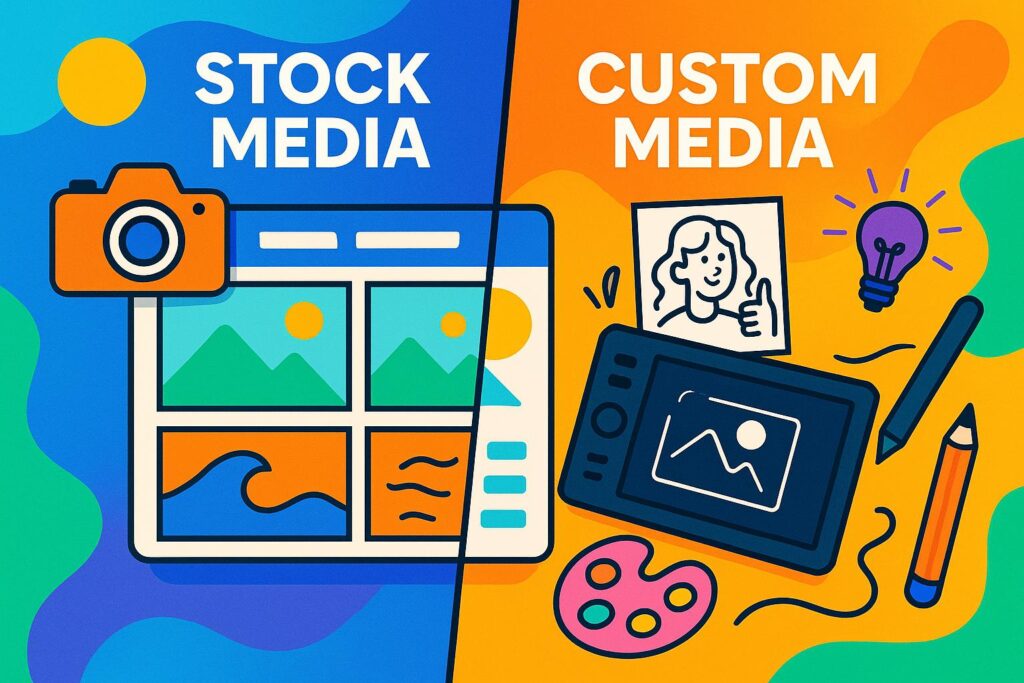
Choosing between stock and custom media boils down to your needs, budget, and timeline. Stock media is quick, affordable, and suited for general purposes, while custom media offers exclusivity and brand alignment but requires more time and money. Here’s a quick breakdown:
- Stock Media: Pre-made visuals you can license instantly. Ideal for tight budgets, quick turnarounds, and filler content. Costs typically range from ₹75 to ₹1,125 per image. However, it lacks uniqueness and may feel impersonal.
- Custom Media: Tailored visuals created for your brand. Perfect for building trust and showcasing your team or products. While more expensive and time-consuming, it gives you full control and exclusivity.
Quick Tip: Many businesses use a mix – stock for general needs and custom for key branding moments.
Quick Comparison
| Aspect | Stock Media | Custom Media |
|---|---|---|
| Cost | ₹75–₹1,125 per image | High upfront costs for production |
| Time | Instant access | Weeks for planning and production |
| Uniqueness | Non-exclusive, generic visuals | Exclusive, tailored to your brand |
| Use Cases | Blog posts, email headers, fillers | Homepage, product pages, campaigns |
| Effort | Minimal (search, download) | High (planning, shooting, editing) |
| Trust Factor | Low – generic, staged visuals | High – real team, products, or locations |
| Reuse Potential | Limited | Long-term, reusable assets |
Pro Tip: Use custom visuals for high-impact areas like your homepage or product showcases, and stock visuals for supporting content like blogs or social media posts. This hybrid approach balances cost and quality.
What is Stock Media?
Stock media refers to a collection of pre-made, professional visuals that you can license through online platforms. These libraries are accessible via purchase or subscription plans and include content that’s not created for any specific business. This makes stock media versatile and suitable for a variety of industries [1].
The term "stock" includes a wide range of content like photographs, videos, and illustrations [2]. Popular platforms such as Shutterstock, Adobe Stock, and iStock offer millions of these visuals to meet diverse design needs [3]. Stock media is commonly used across various projects like website banners, headers, blog posts, product pages, social media campaigns, email newsletters, and even print advertisements.
One defining feature of stock media is its generic nature. While this allows the same visual to be used across different industries, it may sometimes limit how well it aligns with a specific brand’s identity [1]. Next, let’s look at the licensing framework that governs how stock media is accessed and used.
Licensing and Access
When you use stock media, you’re not buying ownership of the content – you’re purchasing a licence to use it under specific terms. In India, costs for stock media typically range from ₹75 to ₹1,125 per download, with commercial licences costing as much as ₹22,500 [1]. Licensing options generally fall into two categories: personal and commercial. Many platforms also offer royalty-free models, which allow you to use the content multiple times under defined conditions. On the other hand, rights-managed licences calculate fees based on factors like how and where the content will be used.
It’s important to note that stock media isn’t copyright-free. Proper licensing is required to use these assets legally. Platforms like Shutterstock offer comprehensive licences that clearly outline commercial usage rights, simplifying the legal aspects of using stock content [3].
Most platforms give you flexibility in how you pay, offering both pay-per-download and subscription-based models. This makes it easier to find an option that fits your budget and content requirements [1]. Once you’ve selected the content you need, the process is simple – you can download it instantly with just a few clicks [1]. Libraries are typically well-organised, allowing you to search by category, keyword, colour, or even orientation, which makes finding the perfect visual much easier [3].
However, licensing terms can vary. Some may include restrictions, like barring usage in specific industries or limiting the number of reproductions. It’s always a good idea to review the terms carefully before using any stock media.
What is Custom Media?
Custom media refers to original visuals – photos, videos, illustrations – created specifically for your business. These aren’t generic stock images, but unique assets designed to reflect your brand’s story and personality. Think of photos featuring your actual team and workspace, videos showcasing real product usage, or illustrations that bring out the essence of your brand. Every piece is tailored to your needs, helping you stand out in a sea of cookie-cutter visuals.
Why does this matter? Modern consumers can easily spot generic imagery. Custom media, on the other hand, captures genuine moments – like team interactions or real product use – which not only strengthens your brand identity but also builds trust and emotional connections with your audience.
Custom media can take many forms, depending on your marketing goals. For example:
- Photography: Real images of your team, products, or workspace.
- Videos: From product launches and tutorials to customer testimonials and corporate storytelling.
- Illustrations and Infographics: Creative ways to express your brand’s personality or simplify complex data.
- Animations and GIFs: Dynamic visuals for engaging digital content.
- Interactive Visualisations: Tools that make data both accessible and memorable.
Creating custom media is a more involved process than simply purchasing stock visuals. It requires careful planning, shooting, and editing, which can take weeks and cost more upfront. For context, stock images often range from ₹75 to ₹1,125 per image. However, the investment pays off in exclusive, reusable assets. In fact, research shows that 71% of audiences prefer personalised ads, and custom visuals lead to higher engagement and trust.
Next, let’s explore how owning custom media gives you exclusive rights and unparalleled control.
Ownership and Exclusive Rights
One of the biggest advantages of custom media is exclusivity. When you invest in custom visuals, you typically own the content outright or hold exclusive usage rights. This means you have complete control over how and where your media is used. Unlike stock content – licensed to multiple users – custom media is created solely for your brand, ensuring no other company has access to the same visuals.
This exclusivity allows for total creative freedom. You can choose everything from the subjects and style to the final edits, ensuring the media aligns perfectly with your brand. Plus, you can repurpose these assets across various platforms – your website, social media, print ads, or even product packaging – without worrying about additional licensing fees or restrictions.
Custom media also plays a crucial role in talent recruitment. Authentic photos of your actual team and office environment give potential employees a real sense of your company culture. This not only enhances trust but also creates a genuine impression that resonates with both customers and candidates.
Over time, your collection of custom media becomes a valuable library that grows alongside your business. It’s a consistent, authentic way to reinforce your brand identity across every touchpoint.
Stock Media: Pros and Cons
Stock media can be a handy resource, offering several advantages while also presenting some challenges. Weighing these pros and cons can help you decide if it fits your visual content needs.
Benefits of Stock Media
One of the biggest perks of stock media is its cost-effectiveness, making it ideal for startups and small businesses working with limited budgets.
Another major plus is instant access. Instead of spending time planning, shooting, and editing, you can simply search, download, and use high-quality visuals within minutes – perfect for meeting tight deadlines [1].
Stock media platforms like Shutterstock, Adobe Stock, and iStock offer a vast library of professional-quality visuals. With millions of images and videos spanning countless categories, it’s easier to find polished content that aligns with your brand’s needs [1][3].
Additionally, reputable platforms provide clear commercial usage rights and royalty-free licences, which means you don’t have to worry about copyright issues, model releases, or location permits. These visuals can be used across websites, social media, email campaigns, and print materials without extra production costs [3].
However, stock media isn’t without its downsides.
Drawbacks of Stock Media
One of the main criticisms of stock media is its generic look. Since these visuals aren’t tailored to any specific business, they can feel impersonal and fail to capture your brand’s unique identity [1]. Consumers are quick to spot overly staged or polished stock images.
Another issue is lack of exclusivity. Widely licensed stock visuals may appear on competitors’ websites, weakening your brand’s distinctiveness [1][7]. Moreover, finding images that perfectly match your brand’s colours, style, and messaging can be challenging, leading to inconsistencies in your visual storytelling [1][7].
Licensing restrictions can also be a concern. While stock images are usually royalty-free, certain usage scenarios may involve hidden costs or limitations [7].
From an SEO perspective, stock images offer limited benefits. They often lack relevant keywords, contextual depth, and the engagement potential of custom or user-generated visuals [4]. Finally, stock media can’t showcase your actual team, workspace, or products, which makes it harder to build the authentic connections that audiences prefer. In fact, 71% of viewers favour personalised imagery over generic visuals [4].
Comparison Table
Here’s a quick overview of the pros and cons:
| Advantages | Disadvantages |
|---|---|
| Budget-friendly for small businesses | Generic visuals that may not reflect your brand |
| Instantly available, saving time | Commonly used by competitors, reducing uniqueness |
| Extensive library of professional-quality visuals | Difficult to align with specific brand aesthetics |
| Clear licensing and fewer legal hassles | Potential hidden costs due to licensing restrictions |
| Works across various marketing channels | Recognisable as staged stock imagery |
| Requires no production effort | Doesn’t convey authenticity or emotional connection |
| High-quality, polished visuals | Minimal SEO value and lower engagement |
| Great for supplementary content | Can’t feature real team, workspace, or products |
Custom Media: Pros and Cons
Custom media can be a game-changer for businesses looking to create a unique brand identity, but it comes with a higher initial investment. Weighing the benefits against the challenges can help you determine if it’s the right choice for your needs.
Benefits of Custom Media
Custom media puts you in the driver’s seat, allowing you to control every aspect of production – from casting to editing. This ensures that your visuals align perfectly with your brand’s story and tone[3]. Plus, the exclusivity of custom content means your competitors won’t be using the same visuals, giving your brand a unique edge in a crowded marketplace. For Indian businesses operating in highly competitive markets, this differentiation can make a big impact.
In today’s digital-first world, trust and credibility are critical. Audiences are quick to spot generic or staged visuals, and they respond better to authentic content. Using real images of your employees, behind-the-scenes moments, or your products in action helps establish trust[5]. These genuine visuals resonate more with customers, creating stronger emotional connections.
Another advantage is the versatility of custom media. A single photoshoot or video production can yield assets for multiple platforms, including social media, websites, and print materials[5]. For service-oriented businesses in India – like consulting firms, hospitals, or hotels – custom visuals showcasing your actual team, premises, and local context can be far more compelling than stock images. They demonstrate that you’re a real, established business with a local presence.
While these benefits are compelling, custom media isn’t without its challenges.
Drawbacks of Custom Media
The biggest hurdle with custom media is the cost. High-quality production requires a significant investment in professional photographers, videographers, directors, and editors[7]. For Indian startups or small businesses operating on tight budgets, this can be a major constraint.
Time is another factor. Custom media production involves planning, shooting, and post-production, which can take weeks – or even months[3]. If you’re working on a time-sensitive campaign or need visuals quickly, custom production might not be the best option.
Another limitation is the scope of assets. A single shoot only captures what’s planned, so if you later need different angles or scenarios, you’ll have to schedule another shoot, adding to the expense and time commitment[3]. Unlike stock libraries, where you have access to millions of options, custom media gives you a much smaller pool of assets.
Managing the production process can also be complex. It involves finding the right professionals, briefing them on your brand, and coordinating the entire shoot. For businesses without prior experience in media production, this can be daunting.
For Indian businesses, especially those with limited resources, balancing these challenges with the potential benefits is crucial when deciding whether to invest in custom media.
Comparison Table
Here’s a quick side-by-side look at the pros and cons:
| Advantages | Disadvantages |
|---|---|
| Full creative control over production | High upfront costs for crew, equipment, and editing |
| Aligns perfectly with brand identity | Time-intensive planning, shooting, and editing |
| Exclusive content competitors can’t use | Limited assets from a single shoot |
| Builds trust with authentic visuals | Requires skilled professionals and detailed coordination |
| Versatile assets for multiple platforms | Additional shoots needed for new angles or scenarios |
| Highlights real team, workspace, and products | Not suitable for urgent or time-sensitive needs |
| Creates stronger audience connections | Budget limitations can impact production quality |
| Long-term value as reusable content | Complex logistics and stakeholder involvement |
Custom media has the potential to elevate your brand, but it requires careful planning and resource allocation to make it work effectively. Balancing your goals with your budget and timeline will help you decide if this approach is right for you.
sbb-itb-3716372
When to Use Stock Media vs Custom Media
Choosing between stock and custom media boils down to what your brand needs most: speed and affordability or exclusivity and personalisation. Your decision should align with your budget (₹5,000 to ₹25,000 monthly for visuals), timeline, and how unique your content needs to be. Custom media demands a higher upfront cost and more time – typically one to four weeks for planning, shooting, and editing. On the other hand, stock media is ready to go and can be downloaded within hours [3][8]. Each option serves different purposes, so let’s dive into when each works best.
When Stock Media Works Best
Stock media shines when speed, cost-efficiency, and variety are your top priorities. For instance, if you’re racing to meet tight deadlines for Diwali, Holi, or Independence Day campaigns, stock images can provide ready-to-use visuals in a day or two. This makes them a go-to for startups, freelancers, and small businesses working on limited budgets. Stock libraries excel at delivering polished visuals for generic themes like "innovation" or "teamwork", as well as for filler content like email headers, hero banners, or social media posts.
Stock media is also ideal for high-volume needs. Whether you’re designing training decks or creating a series of Instagram posts, stock imagery can scale effortlessly. However, when your brand needs to stand out with authenticity, stock media may not cut it.
When Custom Media Works Best
Custom media is the answer when your visuals need to reflect your brand’s unique identity. If you’re a D2C brand selling textiles or handcrafted goods, generic stock photos won’t showcase your real products. Similarly, industries like finance, healthcare, and education benefit from using real team members, office spaces, or facilities in their visuals to build trust. Stock images often feel staged and overused, which can dilute your message or confuse your audience.
Custom media allows you to craft visuals that align with your brand’s colours, tone, and story. It’s especially useful for campaigns where originality matters – like India-specific user journeys, patented products, or custom workflows. Plus, if you plan to reuse the visuals for 12 to 24 months, the upfront investment becomes more economical. Even a small boost in trust from high-value conversions, such as B2B leads or premium services, can make the cost of a custom shoot worthwhile [2][6].
Using Both Together
A blended approach can help balance costs while maintaining quality. Use custom media for key storytelling elements – like your homepage hero section, About page, product pages, and case studies. Complement these with stock images for abstract backgrounds, icons, or secondary illustrations that don’t need to feature your actual business. For video production, mix custom footage for product demos or testimonials with stock clips for cityscapes or tech-inspired sequences. This approach saves money and speeds up production.
To keep your content cohesive, build a central library of custom assets, such as team portraits and product shots, and rotate in stock images for blogs, email headers, or social media posts. Make sure the stock visuals match your brand’s colour palette, lighting, and overall style to maintain consistency.
Here’s a quick guide to help you decide:
| Use Custom Media For | Use Stock Media For |
|---|---|
| Homepage hero section | Blog post illustrations |
| About and Team pages | Abstract concept imagery |
| Product detail pages | Background textures and patterns |
| Case studies and portfolio | Icons and generic graphics |
| Key brand campaigns | B-roll and filler footage |
| Testimonial videos with real clients | Seasonal content with tight deadlines |
| Facility and workspace showcases | Generic office or lifestyle scenes |
To maximise efficiency, consider scheduling one or two custom shoots per year. Capture team portraits, product shots, and lifestyle scenarios with real customers that resonate with your Indian audience. Meanwhile, maintain a stock library for quick-turnaround needs like seasonal campaigns or conceptual illustrations.
Before choosing, ask yourself: Does this visual need to reflect your real product, team, or location? Is the campaign high-stakes (like a homepage or flagship ad) or low-stakes (like a blog post)? Do you have the time – more than one to two weeks – to create custom content? And can the visuals be reused across multiple platforms for six to twelve months? Let your answers guide your media strategy.
How Greenmor Can Help with Visual Content Strategy
Your website should tell your brand’s story with visuals that serve a purpose, not just fill space. At Greenmor, visual content is treated as a central part of web development, not an afterthought. Whether you’re setting up an e-commerce platform, a booking site, a blog, or a corporate website, Greenmor collaborates with you to craft a visual strategy that aligns with your brand, maximises performance, and stays within budget. By combining stock and custom media thoughtfully, the team ensures every visual enhances your site’s branding and functionality.
Greenmor kicks off the process with a visual audit, planning workshop, and a set of image and video guidelines. These guidelines include details like your colour palette, preferred photo styles, icon designs, aspect ratios, and file formats. This ensures every visual asset integrates seamlessly across pages and platforms.
"We listen, strategize, and build a site that works for your business."
- Greenmor Team
Once the strategy is clear, Greenmor takes charge of sourcing and implementing visuals. For stock media, they rely on curated lists of trusted platforms, apply strict filters for style and licensing, and edit images to fit your brand’s look by cropping and colour-grading. They even use reverse image searches to avoid overused visuals. When custom media is the better option, Greenmor oversees the entire production process. Starting with wireframes, they identify where custom visuals are needed and create detailed shot lists or design briefs. These include specifications like resolutions, aspect ratios, and compression targets, ensuring that photographers and designers deliver web-friendly assets. Developers then optimise visuals using responsive formats like WebP and AVIF, along with lazy loading, to keep load times fast without compromising quality.
"Every element is crafted to engage, convert, and grow your audience."
- Greenmor Team
For e-commerce websites, Greenmor focuses on custom product photography and short product videos, as these are key to building trust and driving conversions. Multi-angle shots, close-ups that highlight textures, and "in-use" photos tailored to Indian settings – like home interiors or festive scenes – perform far better than generic stock images. Product visuals are optimised for mobile browsing, with consistent backgrounds and dimensions to ensure smooth navigation even on slower data connections.
For blogs and content-heavy sites, Greenmor creates a cohesive visual system. This might include featured image templates, custom iconography, and a blend of stock illustrations with brand-specific overlays. For high-traffic posts or pillar content, they recommend custom diagrams or infographics to make the material more engaging and shareable.
Booking and appointment-based websites – such as those for salons, clinics, coaching centres, or hotels – require visuals that build trust. Greenmor prioritises custom photography to highlight real locations, staff, treatment rooms, or classrooms. These authentic visuals play a critical role in influencing booking decisions, especially in industries like healthcare and hospitality.
Corporate and display sites, which often focus on storytelling and brand identity, benefit from a higher investment in custom imagery. Greenmor helps create visual narratives through team portraits, office photos, leadership shots, and brand films. These elements showcase your company’s culture and values in ways that stock images simply can’t replicate.
"Speed, SEO, and responsiveness aren’t extras – they’re standard."
- Greenmor Team
Performance is a priority in every visual decision Greenmor makes. They compress images, use modern formats, generate multiple resolutions for responsive loading, and enable lazy loading to optimise speed. Recognising the challenges of Indian mobile networks, the team tests visuals on lower bandwidths and older devices to ensure smooth performance. For video content, they often recommend short autoplay loops or click-to-play videos with adaptive streaming to balance quality and load times.
To keep your visual content strategy aligned with future goals, Greenmor conducts discovery sessions to map out the next six to twelve months of web and campaign activities. This includes planning for product launches, seasonal sales like Diwali or Holi, and new service rollouts. During these sessions, they categorise visual needs into “stock-suitable” or “custom-critical” and help you create a prioritised shoot plan within a budget that fits the Indian market. They also assist in setting up internal processes, like guidelines for capturing quick photos or videos and maintaining a central visual library, so your site stays consistent and easy to update.
With Greenmor’s structured and collaborative approach, you won’t have to second-guess your visual choices or worry about performance issues. They manage everything – from strategy and sourcing to production and optimisation – ensuring your website looks authentic, loads quickly, and supports your business goals, whether that’s selling products, booking appointments, publishing content, or building your brand.
Conclusion
Deciding between stock and custom media comes down to matching your visuals with your budget, timeline, and brand needs. Stock media offers a quick and cost-effective solution, giving you instant access to thousands of images and videos. Subscriptions typically range from a few hundred to a few thousand ₹ per month, making it a practical choice for short-term campaigns, experimental projects, or visuals that act as supporting elements rather than the main focus of your brand story. On the flip side, custom media involves a higher initial investment and more planning but offers something stock can’t – genuine, exclusive visuals that reflect your business authentically. For Indian businesses aiming to build long-term trust and engagement, custom visuals often translate into stronger connections and better conversion rates.
For most businesses, a hybrid approach works best. Use stock media for general concepts, quick-turnaround needs, or supplementary visuals like B-roll. Reserve custom photography and video for high-impact areas like your homepage, product showcases, "About Us" sections, and major campaigns. This way, you can start with stock media to get your projects off the ground quickly and gradually transition to custom visuals as your revenue grows.
Before choosing, consider these four questions: How important is this visual for my brand identity and conversions? What is my realistic budget in ₹? What is my deadline? and Do I need exclusive visuals, or will a generic option work? Evaluating each project based on these factors helps you make clear, practical decisions instead of relying on guesswork.
If you’re unsure where to begin or need expert guidance, Greenmor can help. From selecting the right stock images to planning custom shoots, they ensure your visuals are aligned with your goals and drive meaningful results. This kind of support can be especially helpful if your team lacks in-house design or development expertise.
FAQs
Should I choose stock media or invest in custom media for my business?
When deciding between stock media and custom media, it all boils down to your budget, brand identity, and business objectives. Stock media is a convenient and budget-friendly option, perfect for projects that need quick turnaround or have limited funds. The downside? It might not fully capture your brand’s individuality or offer a personalised touch.
Custom media, on the other hand, is crafted specifically for your brand, giving your content a distinct and polished appearance. While it delivers a more professional and unique feel, it often requires a bigger investment of both time and money.
The key is to weigh your priorities and resources carefully. If you’re working on a website revamp or launch, it might be worth consulting with professionals who can help you seamlessly integrate the right media to align with your goals.
How can I effectively use both stock and custom media to build a strong brand identity?
To create a cohesive brand identity that feels both professional and unique, it’s important to combine stock and custom media thoughtfully. Start by ensuring a consistent visual style – match the colours, themes, and overall design of stock media with your custom content. Stock media works best for supporting visuals like backgrounds or general imagery, while custom media should highlight key branding elements like logos or distinctive graphics.
You can also personalise stock media to align more closely with your brand. Adjust the colours, incorporate your logo, or add text overlays to make the content feel more tailored. And remember, always choose high-quality visuals to ensure your website and marketing materials look polished and professional.
What should I keep in mind when deciding between stock and custom media for my website’s visual content?
When planning your budget for visual content, it’s crucial to weigh your specific needs, timeline, and available funds. Stock media is a budget-friendly and easily accessible option, making it ideal for quick-turnaround projects or when working with limited resources.
On the flip side, custom media delivers visuals that are tailored to your brand’s identity. While this option offers a more personalised and unique outcome, it often demands more time and a higher financial commitment.
Think about what suits your brand and project best. If you want visuals that reflect your brand’s distinct personality and leave a lasting impression, custom media is the way to go. But if you need something flexible and cost-effective, stock media can be a smart, practical choice.