
Navigating social media ad compliance in India is critical for avoiding hefty fines and maintaining consumer trust. With stricter regulations under the Consumer Protection Act, 2019, and guidelines from the Central Consumer Protection Authority (CCPA) and Advertising Standards Council of India (ASCI), brands and influencers must adhere to specific rules to avoid penalties.
Key Takeaways:
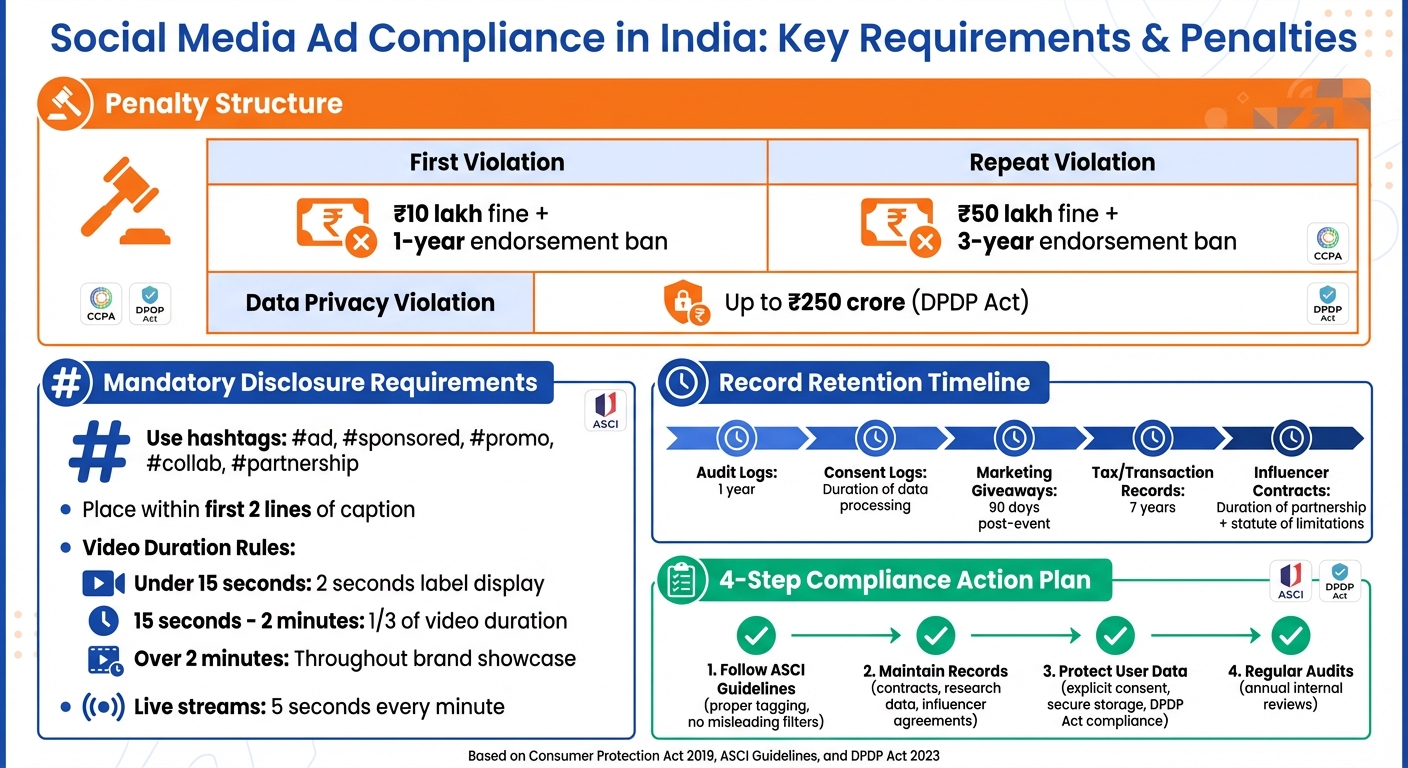
- Fines for Non-Compliance: First-time violations may cost up to ₹10 lakh, while repeat offences can result in penalties of ₹50 lakh and bans of up to 3 years.
- Mandatory Disclosures: Use clear labels like #ad, #sponsored, or #promo within the first two lines of captions or prominently in content.
- Evidence for Claims: All product claims must be backed by credible data, and disclaimers must align with the main message.
- Data Privacy Compliance: The Digital Personal Data Protection (DPDP) Act, 2023, mandates clear consent for data collection, with penalties of up to ₹250 crore for violations.
- Industry-Specific Rules: Additional restrictions apply to sectors like pharmaceuticals, financial services, and tobacco.
Action Steps:
- Follow ASCI Guidelines: Ensure proper tagging and avoid misleading filters or hidden disclosures.
- Maintain Records: Archive contracts, research data, and influencer agreements for audits.
- Protect User Data: Obtain explicit consent, secure data, and comply with the DPDP Act.
- Regular Audits: Conduct internal reviews to ensure ongoing compliance with evolving regulations.
Staying compliant not only avoids legal issues but also builds credibility and trust with your audience.
Social Media Ad Compliance Penalties and Requirements in India
Disclosure and Transparency Requirements
In India, transparency in advertising is non-negotiable. The Advertising Standards Council of India (ASCI) has laid down clear rules requiring influencers and brands to use specific disclosure labels like #ad, #collab, #promo, #sponsored, or #partnership. These labels are essential to help consumers distinguish promotional content from unbiased recommendations [4]. Properly tagging promotional content not only aligns with ASCI guidelines but also shields brands from potential legal troubles.
Using Hashtags and Labels Correctly
To comply with ASCI’s rules, disclosures must be placed within the first two lines of any caption. This ensures users can immediately identify promotional content without needing to click "see more" or scroll down [4]. Hiding disclosures among unrelated hashtags or placing them at the end of long captions does not meet these standards.
Disclosures should also be tailored to the content format:
- Images: Use overlays, such as on Instagram Stories.
- Audio: Mention disclosures at both the beginning and end.
- Videos: Follow specific duration guidelines:
- For videos under 15 seconds, display the label for at least 2 seconds.
- For videos between 15 seconds and 2 minutes, show the label for one-third of the video’s duration.
- For videos longer than 2 minutes, keep the label visible throughout the segment where the brand or its benefits are showcased [4].
For live streams, display the disclosure for 5 seconds at the end of every minute. This ensures viewers joining mid-stream can still identify the promotional nature of the content. Additionally, any material connection – whether it involves cash payments, free products, trips, hotel stays, media barters, or awards – must be disclosed [4].
"The disclosure label should be upfront. It should appear ‘within the first two lines’ of any ad related content so that the users do not have to click on ‘see more’ or ‘scroll under the fold’ to make out if the content is in fact a promotional post."
– Ikigai Law [4]
Platform-Specific Disclosure Rules
Each platform adds its own layer of requirements to these general guidelines. For instance, Instagram’s "Paid Partnership" tag and Facebook’s "Sponsored" feature must be used alongside ASCI’s standard disclosure labels, not as a replacement. This ensures complete compliance and avoids penalties [4].
Disclosures must remain clear and prominent on all devices, whether viewed on a mobile phone or laptop, and should be in English or a language that resonates with the audience. Additionally, influencers must avoid using filters that could mislead consumers, such as whitening filters in toothpaste ads. Influencers are also encouraged to obtain written confirmation from advertisers to support any technical or performance claims. Including clauses about disclosure rules, filter usage, and due diligence in contracts between influencers and brands can further safeguard both parties [4].
Avoiding Misleading Claims in Ads
Grabbing attention with bold claims might seem like a smart advertising strategy, but without solid proof, it can land you in serious legal trouble. Indian regulations make it mandatory to back up every claim – whether it’s about performance, health benefits, or product superiority – with credible, verifiable data [2]. There have been instances of regulatory action against misleading advertisements in the past, highlighting the importance of ensuring your claims are thoroughly substantiated.
Backing Up Product Claims with Evidence
When it comes to social media ads, every factual statement needs to be supported by relevant data [2]. For food or health-related products, claims about nutritional or health benefits must be validated through recognised scientific methods [5]. If your ad mentions being "supported by" or "based on" research, make sure to clearly cite the source and date of the study [2]. Keep detailed records handy for any regulatory review.
Disclaimers won’t save you from a misleading claim. They need to be clear, prominent, and presented in the same language and font size as the main claim. Most importantly, they should not contradict your primary message [2]. For comparative claims in food products, there must be a relative difference of at least 30% in energy or macronutrients, and at least 10% of the Recommended Dietary Allowance (RDA) for micronutrients (excluding sodium) [5].
Restrictions for Regulated Industries
Some industries face stricter advertising rules in addition to the requirement of substantiating claims. The pharmaceutical sector, for example, prohibits ads for prescription-only drugs listed under Schedule H, H1, and X of the Drugs and Cosmetics Rules. Non-prescription drugs must have a licence from the Central Drugs Standard Control Organization (CDSCO), and products claiming to treat diseases listed in Schedule I of the Drugs and Magic Remedies (Objectionable Advertisements) Act, 1954, cannot be advertised [3].
In financial services, ads must clearly disclose the name of the licensed service provider, whether regulated by the RBI, SEBI, or IRDAI. Terms like interest rates and repayment periods must be accurately represented. Digital lending platforms are required to reveal their partnering bank or NBFC and must avoid making promises of quick profits or guaranteed returns [3].
Indian Consumer Protection Laws
Indian consumer protection laws take advertising guidelines a step further by defining clear legal boundaries and imposing penalties to uphold ethical practices. These laws ensure that everyone involved – whether brands or individual endorsers – follows ethical advertising standards.
The Consumer Protection Act, 2019 defines misleading advertisements as those that include false descriptions, guarantees, unfair trade practices, or omit critical information [8]. The Guidelines for Prevention of Misleading Advertisements and Endorsements, 2022 extend to all platforms, covering everything from social media influencers to metaverse ads and even disappearing or pop-up advertisements [8].
What makes this law more stringent is the shared accountability. Responsibility isn’t just limited to brands – it also includes manufacturers, service providers, advertising agencies, and endorsers. For example, influencers on platforms like Instagram or YouTube are legally required to ensure their endorsements are genuine, up-to-date, and based on adequate information [8].
The law also bans deceptive practices like surrogate advertising, where a permitted product’s identity is used to promote a banned one, and bait advertising, which tempts consumers with unrealistically low prices while offering limited stock. Advertisements claiming products are "free" must clearly state any additional costs, such as unavoidable delivery charges. Looking ahead, by June 2025, e-commerce platforms will need to conduct self-audits to identify and eliminate dark patterns – design tactics that mislead users [7].
Fines and Penalties for Non-Compliance
The Central Consumer Protection Authority (CCPA) actively enforces these laws. By mid-2022, the CCPA had issued 113 notices – 57 for misleading advertisements and 47 for unfair trade practices [9]. Penalties for violations are steep, ranging from ₹10 lakh for first-time offences to ₹50 lakh for repeat violations [8].
| Violation Type | First Penalty | Subsequent Penalty |
|---|---|---|
| Misleading Advertisement | Up to ₹10 lakh | Up to ₹50 lakh |
| Endorser Violation | Up to ₹10 lakh + 1-year ban | Up to ₹50 lakh + 3-year ban |
For endorsers, the penalties don’t end with fines. They can also be barred from making future endorsements for up to 1 year for a first offence and up to 3 years for subsequent violations [9].
Self-Declarations and Record Keeping
Advertisers must maintain detailed documentation to back up every claim made in their ads. This includes data, reports, or independent research [2]. If an ad claims to be "supported by" or "based on" research, the source, date, and specific metrics – such as the number of participants – should be recorded [6].
Endorsers also need to disclose any material connection they have with the advertiser. This includes financial stakes, paid partnerships, or even receiving free products. Such transparency is crucial to maintain the credibility of endorsements [8]. Additionally, advertisers must obtain written consent before using a celebrity’s or institution’s name or image in their campaigns [2].
To stay compliant, businesses should organise their records meticulously, as regulatory reviews may require immediate evidence. Companies operating on digital platforms are encouraged to submit declarations showing they’ve conducted self-audits for dark patterns, demonstrating their commitment to ethical practices [7]. Setting up internal systems to review ads regularly can help businesses stay ahead of regulatory scrutiny while ensuring transparency in their advertising efforts.
Data Privacy in Targeted Ads
When it comes to targeted ads, protecting consumer data is just as important as crafting compelling ad content. Running targeted campaigns on social media involves collecting user data, which comes with strict legal responsibilities. With the introduction of India’s Digital Personal Data Protection (DPDP) Act, 2023, the way businesses handle personal data in advertising has undergone a major transformation. Non-compliance can lead to hefty penalties of up to ₹250 crore per violation [10]. In India, data privacy has become a vital aspect of ethical advertising practices.
Compliance isn’t just about avoiding fines – it’s also about earning consumer trust. The law emphasises that consent is non-negotiable. It must be free, specific, informed, and unambiguous, and users must actively opt in to provide their consent [10].
Getting User Consent for Data Collection
Before gathering any personal data for targeted ads, you need to be upfront with users. Provide a clear and simple notice explaining what data is being collected, why it’s being collected, and how users can withdraw their consent later [10]. Forget about assumptions – silence or pre-ticked boxes don’t count as consent. Users must take a clear affirmative action to agree to data collection [10].
If you’re dealing with sensitive information, such as financial, health, or political data, explicit opt-in consent is required. On some platforms, this may even mean obtaining prior written permission [3].
For campaigns targeting children, the rules are even stricter. The DPDP Act and 2025 Rules ban tracking, behavioural monitoring, or targeted ads aimed at children [13]. If your platform caters to users under 16, you’ll need to implement age verification measures and secure parental consent [12].
To stay on the right side of the law, consider using a Consent Management System (CMS). This tool helps you track, record, and maintain a detailed log of when and how consent was given, denied, or withdrawn [10]. These records must be kept for at least seven years, and withdrawing consent should be as straightforward as giving it [10].
Protecting User Data
Once you’ve obtained consent, the focus shifts to safeguarding the data. The DPDP Act requires businesses to implement stringent security measures to protect user information [10]. This includes using tools like encryption, two-factor authentication (2FA), firewalls, and access controls [11].
If your business is classified as a Significant Data Fiduciary (SDF), you have additional responsibilities. You must appoint a Data Protection Officer (DPO) based in India, conduct annual independent audits, and carry out data impact assessments [10]. Even if you’re not an SDF, having a dedicated privacy lead to oversee compliance and handle grievances is a smart move [10].
Data retention should be limited to what’s necessary. Once the purpose for collecting the data is fulfilled, securely and permanently delete it [10]. While audit logs should be kept for at least a year [14], avoid holding onto data longer than required for your advertising goals [13].
If you collaborate with third-party vendors like ad tech providers or cloud platforms, make sure to establish binding Data Processing Agreements (DPAs) [10]. These agreements should clearly define their security obligations and require them to notify you of any data breaches. Remember, as the primary Data Fiduciary, you are ultimately responsible for their actions [10].
In case of a data breach, you must notify the Data Protection Board within 72 hours [12].
| Requirement | DPDP Act (India) | GDPR (EU/International) |
|---|---|---|
| Max Penalty | ₹250 crore [10] | 4% of annual turnover or €20 million [12] |
| Breach Notification | To Board and Data Principals [10] | Within 72 hours to regulators [12] |
| Consent Standard | Free, specific, informed, unambiguous [10] | Explicit opt-in; right to withdraw [12] |
The Indian government has allowed an 18-month compliance period for gradual implementation, with full enforcement expected by 13th May, 2027 [14]. Use this time wisely to map out your data processes. Identify what personal data you collect, where it’s stored, who has access, and how long it’s retained [10]. Set up a clear grievance redressal system so users can raise concerns or complaints about their data, and ensure responses are provided within 90 days [13].
sbb-itb-3716372
Keeping Compliance Records
Maintaining detailed compliance records is not just a good practice – it’s essential for protecting your business during audits. These records serve as proof that your advertising campaigns adhere to regulations. When authorities like the CCPA or ASCI conduct audits, having the right documentation to back up every claim, disclosure, and partnership is critical. Even if your campaigns are fully compliant, the absence of proper records can still invite legal challenges.
Failing to maintain compliance records could result in penalties of up to ₹10,00,000 for a first offence and ₹50,00,000 for repeat violations [2]. But beyond avoiding fines, these records help in resolving disputes with influencers, addressing consumer complaints, and demonstrating integrity during audits. For instance, ASCI now uses the AI-driven "Reech Influence Cloud" platform to monitor social media posts for missing disclosures [16]. In such scenarios, your records become your strongest defence.
Contracts with Influencers
A clearly defined, written contract is a must when working with influencers. Casual agreements, like those made over WhatsApp, won’t hold up in court. Your contracts should explicitly outline compliance responsibilities, including adherence to the ASCI Guidelines and the Department of Consumer Affairs’ Endorsements Know-Hows (EKHs) [33,34].
Contracts should also include clauses on due diligence. Influencers must confirm they’ve personally used the product or verified the brand’s claims before endorsing it [34,35]. This became especially important after the 2019 Marico Limited case, where the Bombay High Court ruled against YouTuber Abhijeet Bhansali (aka "Bearded Chokra") for making unverified claims about Parachute Coconut Oil. The court emphasised that influencers have a "higher responsibility" to avoid misleading the public [20].
Additionally, contracts should prohibit the use of deceptive filters that exaggerate product effects, like making teeth appear whiter or hair shinier than they truly are [4]. They should also address tax compliance under Section 194R of the Income-tax Act, which requires a 10% TDS on freebies or benefits exceeding ₹20,000 in a financial year [19]. Even barter arrangements involving free samples need proper documentation and disclosure [34,36].
These contracts not only set clear expectations but also support record retention and verification efforts.
Document Retention and Verification
Proper documentation doesn’t end with disclosure – it extends to archiving all related records in an organised manner. For example, Self-Declaration Certificates (SDCs) are mandatory for food and health product ads to confirm that the content isn’t misleading [15]. Similarly, scientific substantiation reports are crucial for technical or performance claims, including proof for statements like "clinically tested." Such documentation should include the source of the study, its date, and participant details [7,3].
For influencer campaigns, keep archived posts with timestamps and device screenshots to verify that disclosures were made on time [31,7,34].
Retention periods vary depending on the record type. Under the Digital Personal Data Protection (DPDP) Act, audit logs must be retained for at least one year, while tax and transaction records should be kept for seven years [18]. Consent logs must be preserved for the entire duration of data processing to ensure auditability [17]. For marketing giveaways, retain entries for 90 days after the winner is announced [18]. Automating the deletion of records after their retention period can help avoid liabilities related to over-retention. However, it’s best to notify users 48 hours in advance of any automated data deletion [18].
| Record Type | Recommended Retention Period | Legal/Regulatory Basis |
|---|---|---|
| Audit Logs | 1 Year | DPDP Act Rule 6 [18] |
| Tax/Transaction Records | 7 Years | Indian Tax Laws [18] |
| Marketing Giveaways | 90 Days post-event | Purpose Limitation (DPDP Act) [18] |
| Consent Logs | Duration of data processing | DPDP Act (Auditability) [17] |
| Influencer Contracts | Duration of partnership + statute of limitations | Contractual/Legal Defence |
Using Professional Services for Compliance
Navigating social media ad compliance in India requires a thorough understanding of regulations like the MIB’s Digital Advertisement Policy and the ASCI Code. For industries such as finance and healthcare, outsourcing compliance tasks to experts can simplify the process, ensuring adherence to complex legal requirements while helping avoid costly mistakes. This approach complements earlier discussions on compliance by ensuring that every advertisement aligns with the latest legal standards.
How Agencies Help with Ad Compliance
Compliance agencies specialise in managing platform-specific verifications. For example, they handle processes like Google’s Financial Services verification, which relies on third-party validation. In early 2022, Google updated its verification system for "Approved Third Parties" in India. Under this framework, authorised financial advertisers must initiate verification for their marketing partners by submitting a Google form with the agency’s Customer ID and a warranty of approval. This ensures that agencies can manage financial promotions for licensed clients, while the primary advertiser remains accountable for the campaigns [22].
Agencies also take care of mandatory filings, such as the Self-Declaration Certificate (SDC) introduced by the MIB in June 2024. This certificate ensures that advertisements comply with the Cable Television Network Rules and journalistic standards [15].
"By the intervention of independent agencies to audit the ad campaigns and influencer activities, this would act as a guarantee for compliance with the guidelines" – Mahima Gupta and Smita Pandey, Naik Naik & Company [15]
Additionally, these agencies monitor influencer disclosures, audit advertising claims, and manage issues related to intellectual property and privacy. They ensure that all consent requirements – both legal and platform-specific – are met [3].
For businesses building a digital presence to support advertising campaigns, services like Greenmor (https://greenmor.in) can assist in creating compliant websites. They design landing pages, disclaimers, and privacy policies that align with ad content, reducing the risk of technical non-compliance and ad rejections.
Benefits of Outsourcing Compliance Work
Outsourcing compliance tasks to professional agencies offers several advantages, from operational efficiency to strategic risk management.
First, it saves time. Instead of your team grappling with intricate guidelines like the CCPA and ASCI codes, agencies handle the heavy lifting.
Second, it reduces errors. Agencies maintain detailed documentation, ensuring disclaimers accurately reflect ad claims and that all records are in order [1][2].
Third, outsourcing helps you stay updated with changing regulations. Regular compliance reviews – recommended at least annually – ensure your campaigns meet the latest standards. For instance, Indian advertisers promoting financial services on Google must obtain a unique third-party verification code from G2RS before running ads [22].
Finally, it significantly lowers risk. Non-compliance can lead to hefty penalties, with fines under the CCPA Guidelines reaching up to ₹10,00,000 for a first offence and ₹50,00,000 for subsequent violations [2]. Professional agencies ensure that your campaigns meet all statutory requirements before launch, protecting your business from such financial setbacks.
When selecting a compliance partner, look for agencies with deep expertise in Indian regulations, strong auditing capabilities, and the ability to train your internal teams and influencers [15]. Agencies that carry the ASCI Commitment Seal are a smart choice, as it reflects their dedication to ethical advertising [1].
"Having an ad complained against can be costly. At ASCI we want you to produce successful campaigns that also follow the rules" – ASCI [1]
Conclusion
Navigating India’s ever-changing digital ad landscape requires a strong commitment to compliance. It’s not just about avoiding penalties – it’s about building trust with consumers and ensuring your business operates responsibly. Non-compliance can carry steep consequences, with endorsers found guilty of promoting misleading advertisements facing bans from endorsements for up to three years [2].
India’s regulatory framework is evolving quickly. For instance, in January 2025, new online advertising rules introduced stricter compliance measures [15]. With such rapid changes, regular audits – ideally conducted annually – are essential to ensure your campaigns meet updated regulations and platform-specific guidelines [21]. Staying vigilant is the only way to keep up with these shifting standards.
"With great influence comes great responsibility. The effectiveness of these rules will ultimately depend on how well all stakeholders engage with each other." – Mahima Gupta and Smita Pandey, Naik Naik & Company [15]
Maintaining detailed documentation is critical. This includes records of claims, supporting research, and influencer contracts, which act as safeguards during regulatory audits. For example, the Advertising Standards Council of India has addressed over 85,605 complaints related to advertising standards [1]. Recent cases, such as those involving Yardley London and NDTV in December 2025, demonstrate that even prominent brands are subject to scrutiny [1].
Ultimately, compliance isn’t just a legal obligation – it’s a strategy for building a solid reputation and fostering operational efficiency. With 86% of consumers placing high importance on data privacy and transparency [23], adhering to the rules creates a foundation of trust that fuels long-term success. Whether you manage compliance in-house or collaborate with professional agencies, investing in ethical advertising practices is a step toward securing consumer loyalty and enhancing your brand’s credibility.
FAQs
What are the penalties for not following social media advertising regulations in India?
Non-compliance with social media advertising laws in India can lead to serious repercussions. Companies could be fined as much as ₹50,00,000, and in certain situations, individuals involved might even face imprisonment. To steer clear of these penalties, it’s essential to ensure your advertisements adhere to all legal and ethical guidelines.
How can influencers properly disclose promotional content as per ASCI guidelines in India?
Influencers in India are required to be transparent about their connections with brands whenever there’s a material connection. This includes payments, free products, affiliate links, or any other perks. The Advertising Standards Council of India (ASCI) mandates the use of specific hashtags like #ad, #sponsored, or #partnership to clearly label such content.
These disclosures need to be clear and upfront, appearing right at the start of a post or within the first few seconds of a video. The language and font size should match the main content, ensuring it’s easy to spot, even on a mobile screen. For content aimed at regional audiences, the disclosure must also be in the same regional language as the content itself.
By adhering to these guidelines, influencers can align with ASCI’s regulations and make it simpler for their audience to recognise promotional material.
How can businesses ensure their social media ads comply with data privacy laws in India?
To meet the requirements of India’s Digital Personal Data Protection (DPDP) Act, businesses running social media ads must make user privacy a top priority. The first step? Secure explicit and informed consent before collecting personal data through forms or tracking tools. Always provide users with a straightforward opt-out option to maintain trust and transparency. Collect only the data that’s absolutely necessary for your campaign and avoid repurposing it for anything you haven’t disclosed.
Be upfront about your practices by including a clear and detailed privacy notice. This notice should outline what data you’re collecting, why it’s needed, and how long you plan to keep it. When dealing with sensitive information, use encryption to protect data both during transmission and while it’s stored. If a data breach occurs, it’s crucial to notify the regulator within 72 hours and promptly inform the affected users.
Appointing a Data Protection Officer (DPO) is another key step. This person will oversee compliance efforts, and regular audits should be conducted to ensure everything stays on track. Additionally, invest in training your staff so they’re always up-to-date with the latest privacy regulations. By taking these measures, businesses can run ad campaigns that are both effective and respectful of user privacy.